
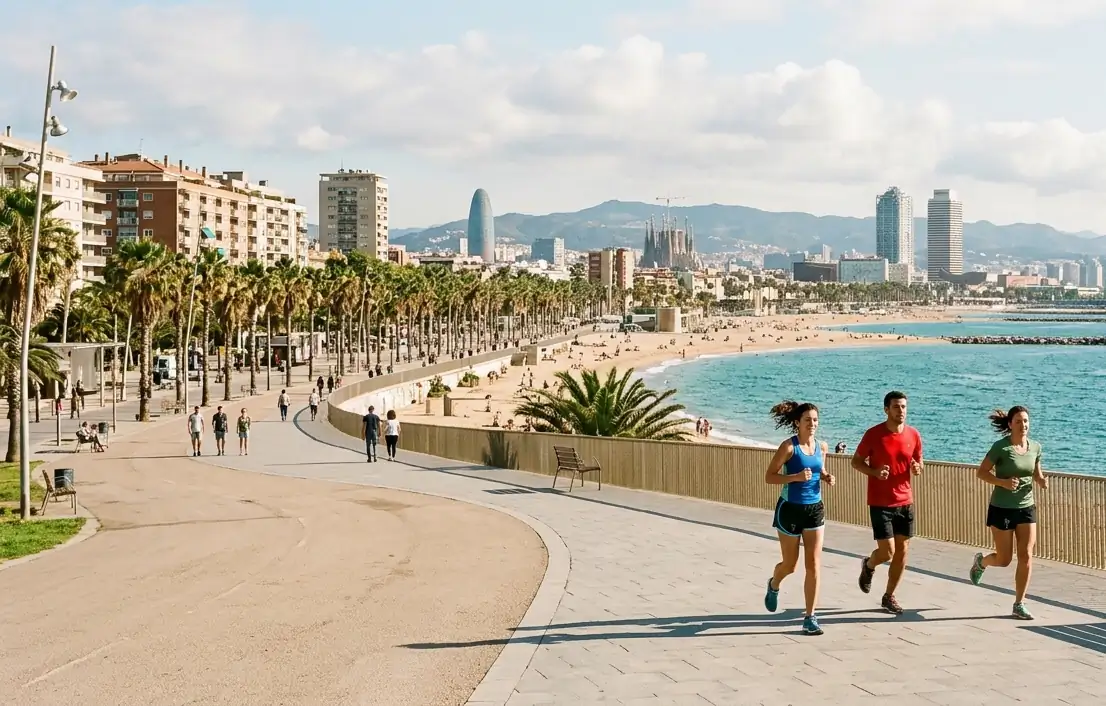
Barcelona is a city you can discover one run at a time. Within a relatively short journey from the centre, you can follow the Mediterranean coastline, climb through the gardens of Montjuïc or head into the wooded hills of Collserola. For international professionals living in the city, these routes offer a way to explore familiar surroundings differently. For business travellers, they make it easier to fit a worthwhile run around a conference, a morning meeting or a busy travel schedule.
The best running route in Barcelona depends on the session you have in mind. The waterfront is the obvious choice for a flat, steady run, while Montjuïc provides more challenging gradients close to the centre. Further north-west, Collserola offers a genuine trail-running environment.
Here is how to choose the right route, find local running partners and make the most of your time in Barcelona.
Distances are planning estimates, not certified course measurements.
1. Barceloneta and the waterfront: Barcelona’s classic running route
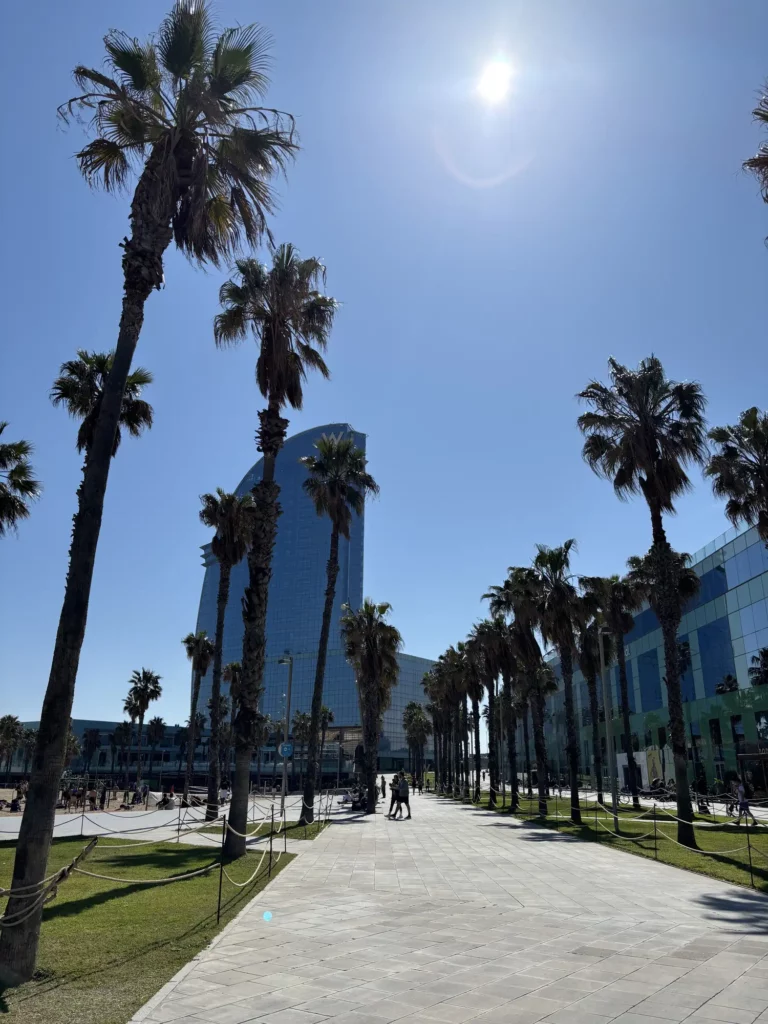
If you have time for only one run in Barcelona, start by the sea.
The waterfront is the city’s most classic running experience: flat paths, open views of the Mediterranean and a route that lets you run at a steady pace without committing to a hill session and no red lights.
Drassanes to Hotel W and back
Suggested distance: approximately 6–7 km return
Start: Drassanes metro station, near the lower end of La Rambla.
Turnaround: the public waterfront promenade near Hotel W Barcelona, also known as La Vela.
From Drassanes, head towards the waterfront and continue along the public seafront paths towards Barceloneta and the Hotel W area. Once you reach the waterfront near the hotel, enjoy the view from the panoramic terrace over the sea and turn around and retrace your steps.
The route is predominantly flat, and its main advantage is simplicity. You can maintain a conversational pace, run without navigating complicated junctions and enjoy a different perspective on the city from the one you see between a hotel and a conference venue.
The experience changes considerably with the time of day. Early mornings are generally the most practical choice for runners who want space to maintain a rhythm, especially during warmer months. Later in the morning and around busy beach periods, expect more pedestrians, cyclists and people using the waterfront.
Local tip: Make time for a post-run stop at Honest Greens. It is a useful option for a snack or lunch, and the surrounding area can be a good place to encounter Barcelona’s active, international crowd.
Extend the run towards Bogatell
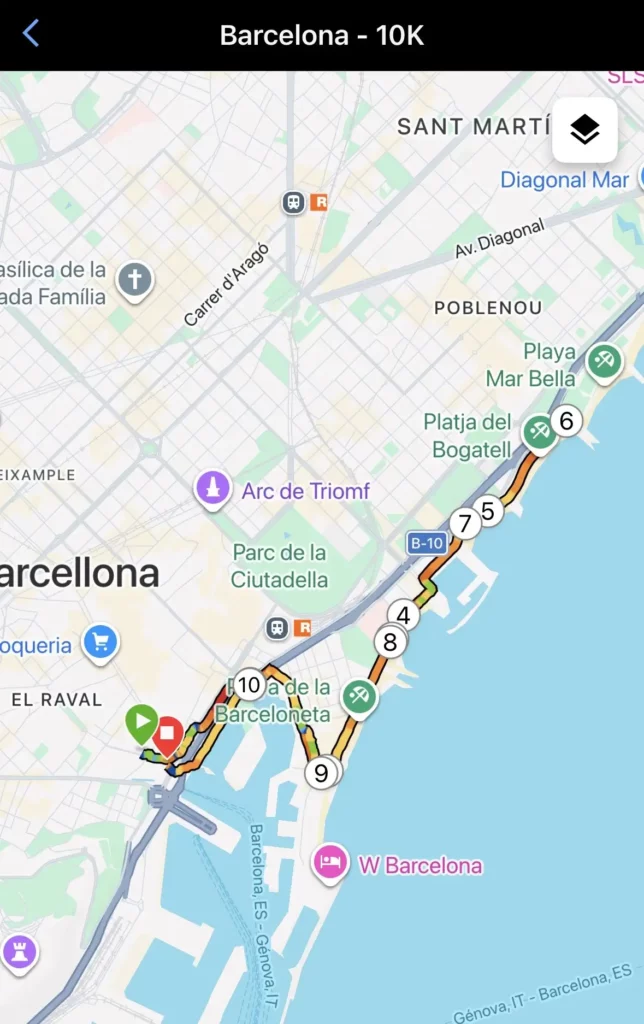
Suggested distance: around 10 km return, depending on where you start and turn around.
If a short coastal run is not enough, continue north-east along the waterfront through the beach areas towards Bogatell and beyond.
This is a natural extension of the central seafront route. Instead of finishing near Barceloneta, continue along the connected public promenades and waterfront paths, using Bogatell Beach as a reference point. A route beginning at Drassanes can reach approximately 10 km return with a suitable turnaround farther along the coast.
The terrain is predominantly flat and paved, making this a good choice for steady-state running, an easy long run or a session where consistent effort matters more than elevation.
For a business traveller, the route is particularly convenient because it can be shortened at almost any point. Turn around when your available time or planned distance requires it.
2. Badalona: a longer run beyond central Barcelona
For a change of scenery, consider heading to Badalona, north-east of Barcelona.
The town has a seafront promenade that provides an alternative to the more central beaches. It can be attractive to runners who want to spend more of their session along the coast rather than weaving through the city’s busiest waterfront sections.
Transport: Barcelona Metro Line L2 serves Badalona, including Badalona Pompeu Fabra and other stations depending on the section you choose.
For a longer coastal run, consider taking the R1 Rodalies train to Badalona, which offers a convenient connection from central Barcelona to the seafront. The R1 stops at Badalona station, providing direct access to the town’s waterfront. From there, you can reach the promenade on foot and start your run along the coast. It’s a practical alternative to the metro, especially if you want to spend more time running and less time navigating through the city.
Route format: an out-and-back along the publicly accessible seafront.
Distance: choose a measured 3–6 km outward section for a 6–12 km return run, adjusting the start and turnaround to match the actual promenade.
The route may feel less urban than the central Barcelona waterfront at certain times, but quieter conditions are an impression rather than a guarantee.
3. Montjuïc: hill training with a city backdrop
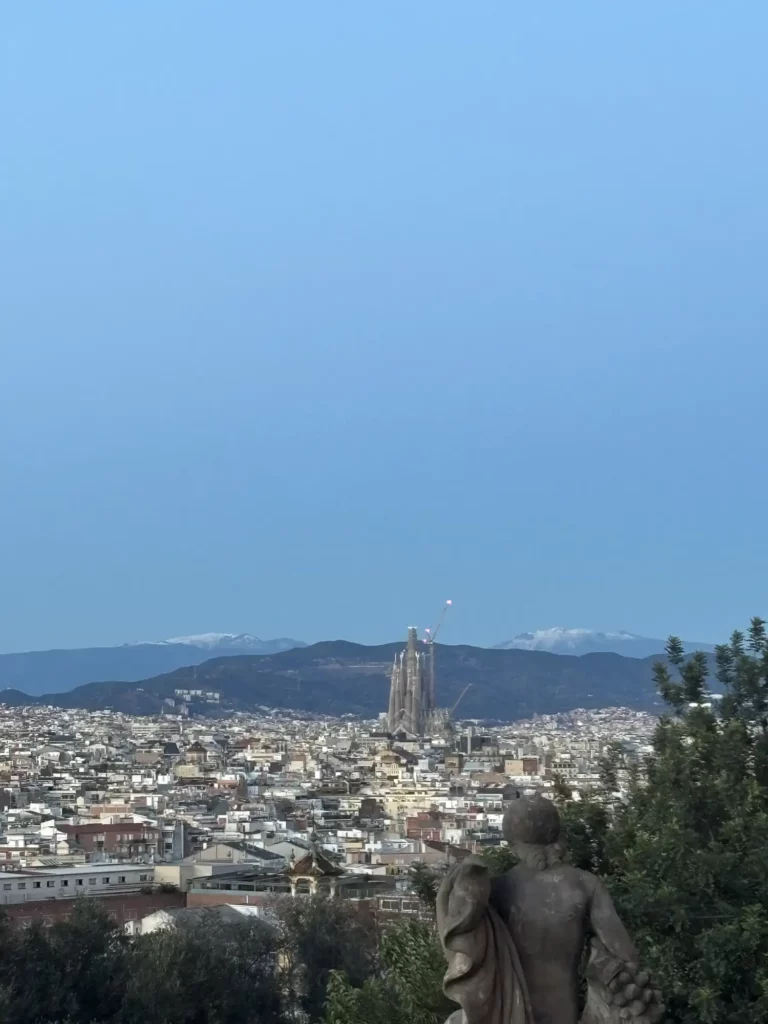
Montjuïc is one of the most useful areas for runners who want elevation without travelling far from central Barcelona.
The hill combines gardens, paved roads, park paths, viewpoints and the Olympic facilities associated with the 1992 Games. That variety makes it suitable for hill repetitions, a challenging aerobic session or a scenic run with sustained climbing.
An urban hill loop
A practical starting point is Plaça d’Espanya. From there, head towards the Montjuïc slopes and build a loop through the publicly accessible paths and roads around the Olympic area, adjusting the turnaround to your target distance.
A loop of roughly 5–8 km can be a useful planning range, but the elevation gain depends heavily on the chosen streets, paths and return route. A route that climbs towards the Olympic facilities and continues to higher viewpoints will be substantially more demanding than a shorter circuit around the lower gardens.
Expect a mixture of asphalt, paved paths and park surfaces. Some sections are steep enough to make this a genuine hill workout rather than a flat recovery run.
Montjuïc is particularly useful when you have already run the seafront several times and want to introduce climbing without organising a longer excursion.
Public transport can reduce the approach, but plan your route around the actual access point and the current operating arrangements. Do not assume that every garden, facility or enclosed area remains accessible at all hours.
4. Horta, Tibidabo and Collserola: trail running near Barcelona

Barcelona’s running options extend well beyond its beaches and urban parks. The Collserola hills provide a substantial network of tracks and trails for runners looking for longer climbs, unpaved surfaces and a more natural setting.
These routes require more planning than the waterfront. Distances, elevation, surface conditions and access can vary significantly, and a route described as a trail on a general travel website may actually be a broad gravel track rather than technical singletrack.
Important: Collserola’s official park website has published access-restriction notices connected with African swine fever prevention. Check the park authority’s latest notice before travelling, and do not enter closed areas or assume that an established trail is currently open.
Carretera de les Aigües: the panoramic classic
Carretera de les Aigües is one of the best-known running routes overlooking Barcelona. The broad track follows the hillside, offering views across the city and the Mediterranean.
The official Collserola park information describes an 18.1 km mountain-bike itinerary beginning and ending at the Sant Pere Màrtir leisure area, with a largely level profile apart from an initial ramp. It also identifies the Pla de les Maduixeres area, near Tibidabo, as an alternative starting point and notes access via the Vallvidrera funicular.
That figure describes a particular itinerary, not a universal running distance. You can choose a shorter out-and-back from an accessible point rather than attempting the full route.
The surface is mainly unpaved, broad and relatively smooth compared with narrow mountain trails. This makes the route useful for sustained aerobic running, although the approach to the track may involve climbing and the terrain should not be confused with a flat city promenade.
For runners staying in central Barcelona, access requires additional travel. Check the current FGC and funicular arrangements, identify the exact trail entrance and allow time for the return journey.
Carry water for longer sessions. Even a broad, relatively level track can become demanding in heat, and facilities should not be assumed to be available along every section.
Horta and the Collserola foothills
Horta is a useful area to consider when you want to reach the green edge of the city rather than start with a long climb from the centre.
However, Horta is a neighbourhood, not a single trail route. Plan a specific itinerary using mapped public paths and roads, with a defined start, finish and turnaround. Check whether the chosen route actually enters the natural park or stays on urban streets around its foothills.
For a mixed urban-and-trail session, a route that climbs towards the Collserola foothills can provide a useful transition from pavement to unpaved surfaces. The elevation gain will depend on the route, and a short distance on a map can conceal a substantial climb.
This option is most appropriate for runners comfortable with route navigation and variable gradients. Verify public access before setting off and avoid following an app blindly into a closed or restricted area.
Tibidabo and deeper Collserola trails
Tibidabo and the surrounding Collserola network offer more demanding options for experienced runners who want longer climbs and forest tracks.
The terrain can include broad tracks, narrower trails and steeper sections. A route to the Tibidabo area should therefore be planned around its actual surface and elevation rather than described simply as a city run.

Before leaving, establish:
- A start and finish point reachable by public transport.
- The total distance and elevation gain from a mapped track or GPX route.
- Whether the route is open under current park restrictions.
- Where you can refill water, if anywhere.
- A realistic return option if you need to shorten the run.
Carry enough water for the planned outing, take a phone with an offline map and avoid unfamiliar trails after dark. In hot weather, exposed climbs can feel considerably harder than their distance suggests.
For an experienced runner with a free morning, Collserola can offer a very different session from the flat waterfront. For someone squeezing a run between meetings, Montjuïc or the coast is usually easier to organise.
5. Parc Güell and alternative green routes

Parc Güell may appear to be an obvious running destination, but it is worth distinguishing between a public park, a visitor attraction and a practical training route.
The park’s steep paths, visitor traffic and access arrangements can make it unsuitable for an uninterrupted run, especially through its busiest areas. Check the current rules and opening arrangements before visiting, and do not assume that ticketed areas are freely accessible for running.
A better option may be to plan a route through surrounding public streets and green spaces, using the hills around the area for short climbs without relying on access to the monument itself.
For a simpler central run, Parc de la Ciutadella offers a more practical alternative. Its paths are generally flatter, and runners can build a short session by repeating sections of the park. It is still a shared public space, so expect pedestrians and adapt your pace accordingly.
The right choice depends on the session: Ciutadella for convenience, the surrounding hills for climbing, and the waterfront for sustained flat running.
6. Running towards Barcelona’s commercial port
The commercial port offers a different perspective on Barcelona’s waterfront, with industrial infrastructure, ships and container terminals creating a striking contrast with the city’s busy beaches.
This is a lesser-known running route, where you can enjoy a quieter and more industrial side of the coastline. The area has a sidewalk and a dedicated bike lane, making it possible to run along the waterfront without entering the port’s restricted operational areas.
The route is generally less frequented than Barcelona’s main running spots, which can be appealing if you prefer a quieter environment. However, it is worth being mindful of your surroundings, particularly if running alone, as some sections can feel isolated and there may be fewer people around.
Before heading out, check the route and make sure you stay on the designated pedestrian and cycling paths, avoiding restricted port areas.
For runners looking for something different from the usual coastal promenade, this can be an interesting alternative, provided you plan your route and take the quieter surroundings into account.
7. Barcelona running clubs for expats and visitors
Running is also a way to connect with Barcelona beyond the office, conference venue or hotel. Several local groups organise social runs, structured workouts or longer sessions that can help visitors find running partners.
The most reliable approach is to check the club’s own channels before attending. Meeting points, schedules and session formats can change.
Good Soles Run Club
Good Soles Run Club describes itself as a social running group based in Barcelona, with regular runs for both beginners and experienced runners. Its Meetup page explicitly welcomes local residents and visitors who want to connect with other runners.
This makes it a relevant option for international professionals staying in Barcelona for a short period. Check its current event listings for the meeting point, distance and registration requirements.
Official links: Good Soles Run Club on Meetup · Instagram · Community and events
Midnight Runners Barcelona
Midnight Runners is an international running community with a Barcelona group. Its official city page describes Bootcamp Runs combining running with exercise stops, track sessions and longer runs.
The format suits runners who enjoy a social atmosphere alongside training. The group describes a typical Bootcamp Run pace range of approximately 4:00–6:00 min/km, with opportunities for runners to catch up at exercise stops.
Check the group’s current event announcements and app information before attending.
Official link: Midnight Runners Barcelona
PB / Prorunners Barcelona
PB-related running groups and Prorunners Barcelona appear in current running-club directories, with listings describing structured sessions such as intervals, tempo runs and longer workouts.
These may be more suitable for runners looking for training structure than a purely social jog.
Start with the current listings on SoleMiles’ Barcelona club directory and verify the relevant group’s official channel.
8. Practical tips for running in Barcelona
Choose your time of day
Early morning is usually the easiest window for a coastal run, particularly during warmer months. It reduces exposure to the midday heat and can make the busiest promenades more manageable.
During summer, take heat and humidity seriously. Adjust your pace, choose a shaded route when appropriate and avoid a demanding hill workout in the hottest part of the day.
Plan water stops rather than assuming they exist
Barcelona has an extensive public drinking-fountain network. The city provides the Fonts BCN app to help users find fountains and consult location information.
That does not mean every fountain will be working when you arrive. Maintenance, temporary closures and local conditions can affect availability.
For a short waterfront run, you may be able to plan around public facilities. For longer coastal sessions and trail runs, carry sufficient water instead of relying on a particular fountain being operational.
Use public transport strategically
The Metro and FGC network can make it easier to reach the waterfront, Montjuïc and the Collserola foothills without running from your accommodation.
Before leaving, check the current route, service and station access. For a trail run, confirm the precise trail entrance rather than assuming that a nearby station puts you directly on the path.
Keep your belongings secure
As in any busy city, stay aware of your surroundings and avoid leaving valuables unattended. If you run with a phone, carry it securely and consider saving the route offline.
For isolated routes, let someone know your plan, take a charged phone and avoid unfamiliar industrial roads or trails after dark. Do not enter restricted port areas or closed park sections.
Choose the route that fits your schedule
If you have 30–45 minutes before breakfast, choose the waterfront near your accommodation or a short loop in a central park. If you have an hour, extend the coastal run towards Bogatell or plan a compact Montjuïc loop. With a free morning, consider Badalona or an appropriate Collserola route, provided access and transport have been checked.
The most useful route is not necessarily the longest or most scenic. It is the one that fits your training objective, available time and practical constraints.
Where is the best place to run in Barcelona?
The waterfront around Barceloneta is a strong choice for a flat, scenic run. Montjuïc is better for hill training, while Carretera de les Aigües and open Collserola trails suit runners looking for unpaved routes and panoramic views.
Can you run 10 km along the Barcelona waterfront?
Yes, a 10 km coastal run can be planned by combining the central waterfront with the promenades towards Bogatell and beyond. Choose a defined turnaround point and measure the complete pedestrian route before setting off.
Is Barcelona good for trail running?
Barcelona has access to hilly terrain and the Collserola natural landscape, including broad unpaved tracks and more demanding trails. Current access restrictions, route difficulty and transport connections should be checked before planning a run.
Are there running clubs in Barcelona for expats?
Good Soles Run Club and Midnight Runners Barcelona are useful starting points for international visitors and residents. Check their current official event information for meeting points, language, pace and registration.
Where can I find drinking water while running?
Barcelona provides public drinking fountains across the city, and the municipal Fonts BCN app helps locate them. For longer runs, hot weather or trail sessions, carry water because individual fountains may be unavailable.
Is the commercial port a good place to run?
Not without verifying the precise route and pedestrian access. Parts of Barcelona’s commercial port are restricted operational areas. Choose publicly accessible waterfront routes instead of entering roads or terminals where pedestrian access is uncertain.
Discover Barcelona beyond the conference venue
Barcelona offers more than one way to explore the city. A short run beside the Mediterranean, a hill session on Montjuïc or a longer outing on an accessible Collserola trail can reveal a different side of the place you are visiting or calling home.
Whether you are in town for a conference, building a life as an international resident or simply looking for a new route, running is a practical way to experience Barcelona beyond your usual professional routine. Plan around your time, choose your terrain and make room to see more of the city at running pace.
Whether you’re visiting Barcelona for business, an event or a personal getaway, discovering the city is always better when you have the right support. At EAS, we help international visitors make the most of their stay in Barcelona, offering tailored accommodation solutions, local expertise and event services. From finding the right place to stay to organizing your experience in the city, our team is here to make your visit seamless. And if running is part of your travel routine, Barcelona offers plenty of opportunities to explore its coastline, neighborhoods and hidden corners at your own pace.
Contact EAS to plan your next stay in Barcelona.
 EAS is a Barcelona-based DMC offering premium MICE services with over 35 years of combined industry experience,
consistently delivering unparalleled event experiences. EAS delivers custom solutions for corporate accommodation
and events in Barcelona, Cannes and other select European locations.


